Feeds:
Posts
Comments

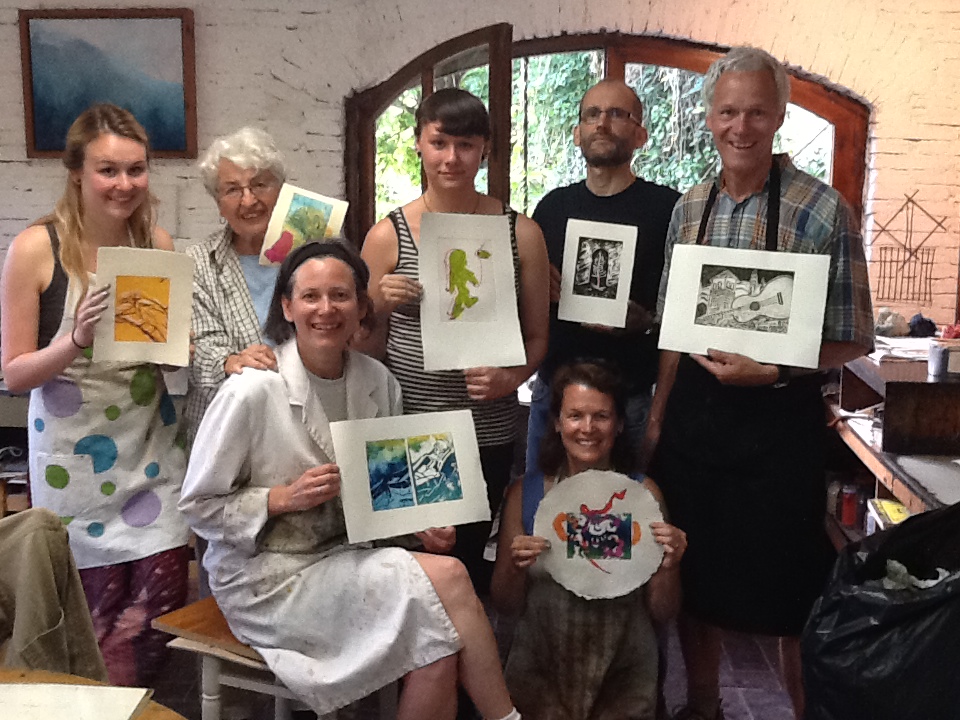
Today, Monday, June 23, 2014, was the last day of Brenda Eubanks’ IB Bremen students’ three-day workshop with Maureen in her studio. It was a morning of putting the finishing touches on the last solar plates and printing up as many of them as time permitted. Then al fresco lunch of curry with all the trimmings and off to the bus. And tomorrow the plane back to Bremen. The above photos show some of the work produced by a group of enthusiastic and attentive 17-year-old art students in three days. Congratulations to all of them.

Here’s what we were listening to: http://youtu.be/Ds8IevHRPGM

Saturday, June 21, 2014–Most of these pictures were made at the table after lunch , which is about the only time the cook has an opportunity to take pictures!

Here’s what we were listening to: http://youtu.be/0svqylN9oLA

This post is rushed to press for Jack, who loves to look at pictures. Stay tuned for more to come next week.

Here’s what we were listening to: http://youtu.be/jxodluTaz4g

My first portfolio, The Owl and the Pussycat, 1979, edited at the Rodríguez-Acosta Foundation

 Photos by Mike Booth

Painting Came First

I was a painter for 16 years before I started studying fine-art printmaking. Like many nice things in my life it happened in a serendipitous way. I had known for some time that Granada had a private art foundation that selected artists from around the world for training in their exclusive printmaking workshop, but I was convinced that I didn’t quality to apply there. I had seen an exhibit of etchings done there and they seemed to me like sheer magic. I thought, “How on earth did they do that?”

Then one day I bumped into my English painter friend, Louise Waugh, and she was over the moon because she had just been accepted to work at the Fundación Rodríguez-Acosta, the printmaking foundation created by Granada artist and philanthropist, Miguel Rodríguez-Acosta. “How did you manage that?” I asked her. “I just presented a portfolio of sketches.” The following week I showed up trembling at the door of the Foundation’s workshop with my portfolio under my arm. A couple of weeks later I received a note instructing me to show up at the taller on Monday morning ready to go to work. I couldn’t believe it.

Pepe Lomas, the Heart and Soul
Pepe Lomas Miguel Rod.-Acosta

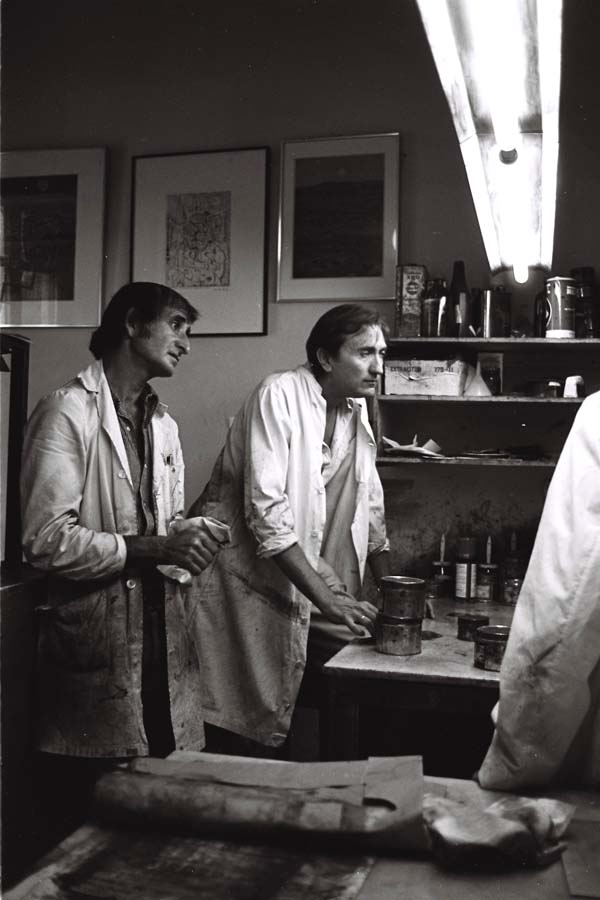
José García Lomas (left) and Miguel Rodríguez-Acosta in the Foundation workshop

The heart and soul of the Foundation printmaking workshop was José García Lomas, the maestro grabador.  Pepe had been formed as a master printmaker in workshops in Italy and in Barcelona and was a meticulous teacher, respectful of his students’ own styles and creativity, always conscientiously avoiding the imposition of his own. I worked under Pepe’s guidance for two and a half years, until the Foundation workshop closed. I thought I was there learning to etch. But now that I have my own workshop and work with artists I realize that my maestro was also, at the same time and by subtle example, teaching me to teach. For that I am eternally grateful.

If Pepe thought you were serious he was lavishly generous with his printmaking knowledge. As I was usually the first one to arrive at the studio and was very keen, Pepe went out of his way to see to it that I was given a proper formation in etching. We would have breakfast together most mornings—café con leche and pastries– at the Sibarí bar on the corner. And when my husband Mike came to pick me up at midday we would all have a couple of wines together at the tapas bar halfway down the block. I was in my element; those were good times.

There weren’t more than a dozen active artists at the Foundation and rarely did more than three or four of them show up at one time. Many days I had the workshop, the maestro and his two assistants all to myself. I felt privileged, like an apprentice in a Renaissance etching studio, only better. I didn’t have to sweep up. Looking back I can conceive of no greater luxury. The norm at the workshop was three or four working proofs per plate. But if Pepe saw you were onto something he would let you keep on pulling proofs for as long as you needed. I say “pulling proofs,” but the truth is I never printed a single plate in all my time at the Foundation. That was always done by one or the other of the two studio assistants, Pepito and Ángel.

The All-Important Atmosphere

Miguel Rodríguez-Acosta

Miguel Rodríguez-Acosta, the workshop’s founder, at work

Whether by luck or by design the Fundación Rodríguez-Acosta studio was an ideal setting for making prints. The walls were lined with benches with individual lights over the work spaces. Except for the light over the big motorized etching press, that was the only illumination and it created an almost monastic atmosphere of seriousness and purpose.  There, under Pepe’s watchful supervision I made my first plate. On it he taught me to use different tools and chemicals to achieve the principal traditional etching techniques: acid etching and aquatint, soft ground, sugar lift, carborundum and dry point, along with something Pepe called “craquelado,” “crackling.”

My maestro was a meticulous artist and teacher and he made me meticulous. He was a stickler for the preparation of the plate, scrupulously polishing the surface and beveling the edges. Sometimes, even today, I’m shocked to see printmakers come into my studio with rough, ragged-edged plates, and I always think of Pepe.

Some of My Early Work

Stay tuned for more to come in Part II

Plaza del Humilladero, Granada, Spain, Sunday June 8, 2014

Here’s a link to the Impresiones Gigantes site: http://impresionesgigantes.wordpress.com

Carole Pearson (Surrey, UK) started painting with oils when she was 12 or 13 years old. “Then, instead of going to art school, I went  to work in a bank,” says Carole, “Not that I miss formal art training. I’ve always suspected–and this week working with Maureen in her studio has confirmed–that my work is more original for not having entered into the system. What Maureen made clearer than ever to me was that what an artist expresses sincerely is all valid.”

Carole, who has been making prints for only a couple of years, had been wondering for some time what it would be like to do a workshop abroad. It occurred to her last month that she could extend her upcoming two-week walking holiday in Andalusia with an additional week of printmaking. “It was easy to find Maureen,” she says. “I just googled “printmaking Spain.”

“I really had no idea what to expect, beyond an etching press and a nice person whom I had been corresponding with by email. But in the end it was a tremendously fulfilling experience. I’m convinced that I’ve advanced more than a year in printmaking in just one week’s intensive work with Maureen. Working one on one with a master is such a luxury.”

What did Carole discover in the foothills of Sierra Nevada outside Granada in Spain last week?

“Aside from the siesta? Nightingales.”

What we were listening to: http://youtu.be/Ds8IevHRPGM


Photos (color) by Brian Berry and (b&w) Francesco D’Apolito (Coraggio il Topo)

The First of this Year’s Impresiones Gigantes Events

The show was an exhibit of work by local and international artists in Granada’s Palacio de Almirantes in the Albaicín quarter on May 6. The artists showed mainly small work–when compared to the giant, road-roller prints we’ll be seeing on Sunday, June 1, in Granada’s Paseo del Salón. The delightful thing about all of the Impresiones Gigantes events is their  authenticity as IG, now in its third year, is a true grass-roots initiative. At this show lovers of art and culture had the opportunity to mingle with the artists in a relaxed and unhurried atmosphere.

IMPRESIONES GIGANTES is a collective of artists who live and work in Granada. Each June for the past three years they have staged an open-air event in the Paseo del Salón Park. It consists of printing huge, one-by-two-meter linocuts with a road roller. The quality of resulting prints is remarkable, and the process is fascinating and fun to watch. It draws ever-larger crowds of art lovers and passers-by each year.

Two dates to remember:

Friday, May 23, 2014 Mayo – 8:30 p.m.

Concert and exhibit of works by Fine and Applied Arts students in DISCOS BORA BORA in the Plaza Universidad

Sunday, June 1, 2014–All day

Impresiones Gigantes III in the Paseo del Salón – A full day of art outdoors; see you there!

Here’s the Impresiones Gigantes website: http://impresionesgigantes.wordpress.com/

Here’s their Facebook page: https://www.facebook.com/events/268821219966603/


Here’s what we were listening to: http://youtu.be/129kuDCQtH

Morgan Solarplate Day

L to R Standing: Tegan Rush, Bernice Morgan, Kat Rush, Greg Morgan, Andy Rush Front Row: Jennifer Morgan and Jackie RushMorgan Happy printmakers!

Maureen Booth writes from Granada–Printmaker Jennifer Morgan has confirmed for me something that I always suspected. Creative artists don’t limit their creativity just to their work. They take it with them in other aspects of their lives. Jennifer and her family were headed to Spain on a vacation organized by her mother, the Canadian novelist, Bernice Morgan. Wouldn’t it be fun, Jennifer mused, if we could find a printmaking studio in Spain willing to mount a one-day workshop for our whole family? Granada sounded good so she went to Google. I received her email shortly thereafter. Would I be willing to organize a one-day workshop for a family of seven?

Sure, why not? I’d never worked with a family group before but I’d done lots of  short courses for school groups. The challenge was whether we could achieve something meaningful in just one day. I decided we could give it a try if we worked both in the morning and the afternoon, with a break at midday for lunch and a short siesta. In the end my husband Mike made his specialty of the house lunch: a big paella that restored everybody’s strength and enthusiasm.

My good luck was that the Morgan clan is uniformly loaded with artistic talent and they took to solarplate printmaking like ducks to orange sauce. Why solarplate? Because it speeds up the printmaking process immensely, permitting us to prepare acetates and burn plates outside in the sunshine in the morning and then dedicate the afternoon to finding creative ways of printing them. In the end they took home a big stack of prints, all of which looked as if they had been done by experienced printmakers.

At the end of the day the Morgans had a 45-minute wait for the bus back to the city, so they spent it gleefully in our local bar between wine and tapas and furious games of “futbolín,” as the Spanish refer to the raucous table soccer game.

Here’s what we were listening to: http://youtu.be/BteIwbKU_iQ


Robyn Smith artist

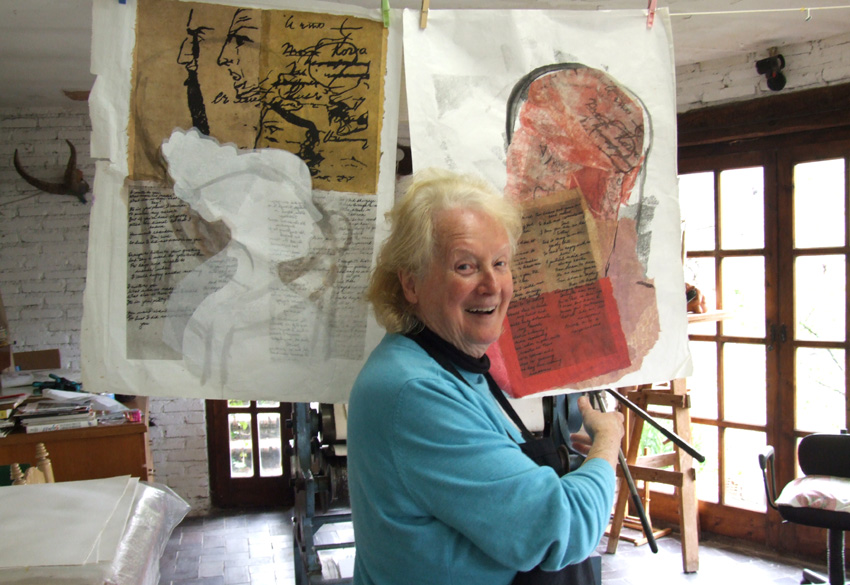
Our friend, Robyn Smith, is so vital, so fun, so down to earth, and such a world bounder she could only be Australian. She turned up at my studio a couple of weeks ago in rather a dither. “I’ve been invited to present a piece in the St. Petersburg (Russia) Biennale and I’ve only got two weeks to get it done. Can I work in your studio? Do you want to help me prepare it?”

Robyn’s association with Russia is not accidental. She began studying the Russian language in Australia in the mid 90’s and made her first trip there in 1997. She was immediately taken with St. Petersburg, made friends there, stayed in touch with them. A few years later Robyn’s Russian professor in Australia introduced her to an artist with a studio in St. Petersburg who offered to share it with her. She ended up living about half of every year there. She says, “I always feel welcome and respected as an artist in Russia, much moreso than in my own country. Since the time of the Russian revolution and until quite recently artists were considered citizens who contributed something to the country and were treated as such. Some of that respect still remains.”

Robyn’s diptych, a tribute to Pushkin, is finished and she’s on her way to St. Petersburg with it under her arm.

Come back soon, Robyn.

Here’s what we were listening to: http://youtu.be/Hphwfq1wLJs

Dates: 15 April – 15 June 2014
Location: National Russian Library in St. Petersburg, Russia
Curator: Inna Grinchel
This international exhibition in the new large exhibition hall of the National Russian Library in St. Petersburg (Moskowskij prospect 165) is dedicated to the Pushkin poem “Eugenij Onegin.” A concurrent exhibition of artists’ books will be held in the Exhibition hall of the City Sculpture Museum. Its opening will be on International Book Day– 23 April.