Posted in Maureen Booth, Printmaking Courses Spain, TASIS | Tagged Maureen Booth, printmaking courses, printmaking Granada, printmaking Spain, printmaking workshops, TASIS | Leave a Comment »
.
Your first portfolio is a milestone. This is the point where you’ve practiced enough printmaking techniques to make a respectable showing with your first formal project. Your confidence has grown to an almost viable level—along with an equally-heightened case of nerves and apprehension. This is the big time. What subject should you choose? What techniques should you employ for this first effort? If I may offer my advice, choose a subject that is familiar to you, something you love and is close at hand. As for techniques, keep it simple. You’re just starting out. There’s plenty of time to get fancy as you go along.
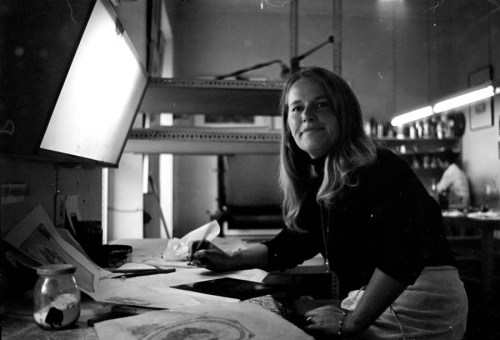
Shall I tell you about my first portfolio? It was 1978 and my maestro, José García Lomas (Pepe Lomas to his friends), suggested that I might be ready to make my first portfolio of prints. I had been studying with him at the Rodríguez-Acosta Foundation in Granada for more than two years. Pepe offered to guide me through process of making the portfolio. What a luxury that was.
He was delighted when I told him I had chosen a nonsense poem, The Owl and the Pussycat, by the English artist, illustrator, musician, author and poet, Edward Lear. This was a poem that, for some reason, I remembered vividly from my childhood. Pepe agreed with me that it offered splendid visual possibilities.
I must confess that the five plates that I created for The Owl and the Pussycat were not precisely simple. I worked on them for six months, pulling untold proof prints. Encouraged all along by my maestro, who wanted to see me show off the techniques he had taught me, techniques that I had practiced every weekday morning for more than two years, I went to work enthusiastically. So the etched zinc plates incorporated line work, aquatint, and soft ground. The Rodríguez-Acosta workshop had a wonderful big aquatint box with paddle bellows and we were still in the age of immortality. I suspect we all breathed a lot more resin than was good for us.
Before I even touched the first plate I did sketches for all five of them. Any comments Pepe made were always limited to technical considerations, as he always scrupulously respected his students’ artistic criteria. I started by varnishing five zinc plates and lightly etching in the basic drawings, then working the plates all up together starting with the aquatint. Though all the plates were different, this approach insured some degree of coherence across the whole portfolio.
We decided on an edition of 50 portfolios and 50 loose sets. Multiply that by five etchings plus a cover illustration and it adds up to 600 prints. Pepe insisted that the whole job be done by Angel and Pepillo, the workshop’s two printing technicians. The artists at the Foundation seldom touched the etching presses. While they did that I went off to find an offset print shop to print the cover text and colophon.
I presented The Owl and the Pussycat along with other work in an exhibition at Granada’s wonderful Palacio de la Madraza, the 14th-century building opposite the cathedral. La Madraza housed Granada’s first university and belongs to the University of Granada today.
This was the most successful portfolio I ever did.
.
Posted in Grabado Granada, Maureen Booth, Maureens printmaking workshops, Obra grafica Granada, Printmaking Courses Spain | Tagged Maureen Booth printmaker, Print Portfolio tips, printmaking Granada, printmaking Spain, printmaking workshops Granada, printmaking workshops Spain | 2 Comments »
And What You Can Do About It in Your Own Work
How many artists have come into my studio on the first day proclaming, “No, I’m not interested in solarplate. I’ve done it and I didn’t like the results.” Then I get out some solarplate work that I and other people have done in my studio and the negativism turn to questions. “How did you get those whites? How did you achieve those velvety blacks and the whole range of tones? These are beautiful prints!”
This happens regularly. Why? Because solarplate prints are (apparently) so quick and easy to make. You just scan or photograph an existing image (sketch, watercolor, photograph…), print it on a transparent acetate with a laser printer, sandwich it under glass with a photosensitive polymer plate, and expose it under sunshine or a UV lamp. Wash and dry it, pull a print of it on an etching press and, bingo, you’ve got a solarplate print. Well, almost. What you’ve actually got is a mediocre solarplate print. Given these results most artists never get beyond this point. It’s a shame as solarplates, when prepared with care and criteria, are capable of yielding beautiful work. With them you can either opt for positive intaglio prints using an aquatint screen, or negative relief prints without the screen.
What’s the big secret. There’s no big secret, but there a lot of little ones, and some of the most important have to do with the preparation of the acetate. It’s your all-important original. If you don’t start with a beautiful acetate you’ll never get a beautiful print. Most of the flaws in a typical solarplate print are introduced in the process of scanning. Even if you start out with an image with a proper range of tones–and no watercolor will ever clear this hurdle–the scanning processs will degrade that image. How do you recover it?
The best way is to skip the scanning/photography process altogether and create your image directly on the acetate using an opaque medium such as India ink or etching ink. You can also use lithographic ink and pencils or permanent black felt pens. This will guarantee you black blacks and brilliant whites. You’re already ahead in the game. Then you can add mid-tones to a positive plate by diluting the ink in various degrees. If you’re using Indian ink dilute with water, if it’s etching ink, with turps.
The aquatint screen, exposed first, before the image acetate, enables you to render tones in your solarplate print, similar to aquatint in an acid etching. Negative plates, similar to a woodcut or linocut, require pure blacks to highlight relief. You can use the same exposure time for the aquatint screen no matter what the light source. The area where you put the black ink will be washed out down to the steel backing leaving the unpainted areas in relief.
If you need to work from a scanned image you will have to adjust contrast in PhotoShop or other image treatment program (or take it on a pen drive to a good photocopy shop and have them do it for you) and then later by hand, working on the acetate. This means cleaning the whites with a cotton bud with a little alcohol and strengthening the black areas with opaque ink, felt pens or lithographic pencils. (NB: Be sure to use special laser acetates. If you use a normal acetate it will melt inside your printer.)
If you don’t have a vacuum exposure unit–and not many of us do–you may have trouble achieving perfect contact betweeen the plate and the acetate during exposure. This is especially important as the plates get bigger and more expensive, as you don’t want to waste many of them! To avoid this problem I add a layer of 15mm-thick foam rubber in what becomes a six-layer sandwich (from the bottom up: backing board, two felt blankets stuck to the board, a sheet of foam rubber, the plate, the acetate and the heavy-duty glass beveled on the edges). All of this I clamp firmly with six spring-loaded C-clamps.
Achieving proper exposure of a solarplate requires both art and science. People who come to printmaking from photography or science backgrounds usually emphasize the former, painters the latter. Both approaches require extensive testing. The photographers tend to do it more systematically, the painters more intuitively. Whatever your inclination, don’t be tempted to rush the exposure testing process. The success of all your solarplates from here on out will depend upon it. And don’t forget to incude the plate wash times in your tests. They are also a factor in getting quality results.(Note: The best light source for exposing solarplates is the midday sun, so you should probably move to Spain or Arizona.)
Pulling your first print from a properly prepared solarplate is a satisfying experience. If you’ve done everything right the improvement is notable. Your first proof print will not be your bon a tiré, however, and it’s still not too late to retouch your plate with a bit of drypoint. Now you enter into the thousand nuances of choosing and mixing inks and printing your plates, not to mention paper selection. I usually refer to this state as “creative printing.”
But that’s another chapter.
P.S. All of the steps in this process are easier to do than to explain. Come on over and we’ll do them together!
I almost forgot. I have made a video tutorial on this subject, available here.
.
Posted in Grabado Granada, Maureens printmaking workshops, Obra grafica Granada, Printmaking Granada, Printmaking in Spain | Tagged Maureen Booth printmaking, printmaking in Granada, Printmaking in Spaiin, printmaking workshops, printmaking workshops Granada, printmaking workshops Spain, solarplate printmaking, Solarplate secrets, Solarplate techniques | 2 Comments »

Here’s wishing a joyous Winter Solstice and a happy and prosperous New Year to all my people.
I want to make you a little gift. If you follow this link (http://youtu.be/4zNnkAbQ-1Y) it will take you to my Printmaking Tips video (one of my Master Printmaking Courses series) that is posted in a secret place on YouTube that can only be accessed with this link. I hope you find something there that might refine your work a little bit.
Two thousand fifteen has been an excellent year for us. Our good friend Rafa Sánchez, the surgeon whom Mike goes hiking with on most weekends, recommended a new doctor to treat my arthritis. Dr. Salvatierra changed my medication, which immediately reduced pain and swelling in my joints. It was like magic. I feel better than I have in years.
My other special joy for this year has been our grand daughter, Lucía, who has been staying with us for a couple of months during her first pregnancy. It’s a boy, due in February. This will be our third great grandchild, as Lucía’s little sister, Elisa, already has two wonderful children, Gabriel 4 and Julia 2.
I’m starting work on a new commission that proves to be challenging and fascinating. An old friend from California, a musician, composer, musicologist, documentary film maker and record producer, wants a portfolio of etchings based on a suite he composed when he lived in our village for a year back in the early 70s. I think I’m over the first hurdle. I’ve decided on an approach to the images. Wish me luck.
A group of 12 students from The American School in Switzerland (TASIS) are coming back this year during their winter break for five days of printmaking in my studio. I love working with young people, and it’s surprising the quantity and quality of work they can turn out. I’ll ask Mike to make some pictures of the workshop and post them here.

Dolly as a baby. Angelic, isn’t she…
Shall I tell you the Dolly saga? Dolly is one of Cuca’s two pups, the one we kept. She’s just over a year old now. The father was a little Jack Russell-type terrier. We should have been forewarned. From early on she constantly tried our patience: hyperactive, chewy, yappy, and if we made her nervous she would take revenge by peeing on our bed. We were always of two minds whether or not to find a good home for her.
Then last month a young woman from the village showed up at our door asking if we had any puppies. She had been promising her two girls (10 and 4) a puppy and had to deliver. As soon as she saw Dolly she was smitten. (As you know, the Devil takes many forms and Dolly is diabolically cute.) As María José walked proudly down the hill with her new puppy on a lead Mike and I exchanged meaningful glances. Had we done it? A week went by. Apparently we had.

Family portrait lacking just a couple of cats.
Then Dolly started showing up at our house from time to time. I would phone María José and she would come up dutifully and retrieve her. She said her girls were wild about Dolly but she was concerned because they never left her alone. If they weren’t dragging her along on the lead they were hugging her on their laps. No peace for the wicked!
A week later María José showed up with Dolly in tow. Her mother had said that Dolly had to go. She had come into heat and, along with her other shennanigans, was making life at their house impossible.
Dolly’s back, but with a difference. She’s almost perfectly behaved. It’s a miracle. She’s so happy to be in a familiar place with old friends–especially her soul sister, Blacky the cat.
Dolly now comes when we call her, goes where we tell her, hesitates for permission before jumping up on the furniture, hasn’t eaten any shoes, socks or plastic kitchen utensils since she’s been back. She’s discreet and affecionate, a pleasure to have around. In short, we have never had such an appreciative puppy.
I almost forgot to mention Mike’s latest project, a new site he started in August. It’s called Somos Pineros (We’re from Pinos) and it showcases the photographs he has made in our village since we arrived here, pictures from the end of the sixties till day before yesterday. The text is in Spanish but the images are universal. Here’s the link: http://somospineros.com.
Do take good care of yourselves next year and come and see us when you can. Printmaking is good for you!
Posted in Maureen Booth, Maureens printmaking workshops, Printmaking Courses Spain, Printmaking Granada, Printmaking in Spain | Tagged Maureen Booth, printmaking courses Spain, printmaking in Granada, printmaking in Spain | 1 Comment »
Unexpected treat for Lola Sánchez and Teresa Gómez
After the poetry reading and presentation of Teresa and Lola’s artists’ book created and edited in my studio, Cinco Minutos Nada Menos (Five Minutes No Less) at the Library of Andalusia in Granada, the library’s director expressed an interest in acquiring a copy of the work for inclusion in their permanent collection. This was the frosting on the cake after selling out the rest of the edition on the night of the presentation, with all the proceeds going to Médicos sin Fronteras (Doctors without Borders).
Congratulations to everybody!
.
.
P.S. While Teresa and Lola were in the meeting with Javier Álvarez, the director of the library, they mentioned my own artist’s book, Entredós, Between Two (scroll down towards the bottom) and he decided to add one of those to the permanent collection, as well. It was a good day for everyone.

Posted in Andalusian Library Granada, Artists books, Biblioteca de Andalucía | Tagged Artists Books, Biblioteca de Andalucía, Lola Sánchez, Maureen Booth, Teresa Gómez | Leave a Comment »
The Importance of Having a Great Assistant
We talk a lot about the creative part of printmaking but there’s another aspect which is also creative, but somewhat less: the production side. If you’re going to sell prints you have to edition them. Depending upon the numbers involved–I try to keep my editions under 50–editioning can become a trudge.
Enter the assistant, who can make all the difference. I’ve had a few. When Rodrigo, who was excellent and had worked with me frequently for a number of years, went back to Argentina, I was left on my own. Then an old friend of ours, Maria Jose Braojos, wife and co-producer of Juan Carlos Romera, the video producer who has made all my videos, offered to help me out. I was delighted.
Maria Jose and I have been working together for more than a year now and she has proven to be the ideal helper. It’s not just for her technical ability and her punctillious character, which keeps print quality highly uniform. It’s also because she’s great company, always cheerful and optimistic, always generous with her time and discreetly helpful with her suggestions. Maria Jose’s great, and I want this post to be an homage to her. I asked Mike to make some pictures of us working in the studio yesterday and he kindly said yes. (If you ask me he went off the rails a bit, but he’s entitled to his creativity, too.)
I hope you enjoy this photo essay on a morning of editioning in my studio. Better yet, come on over and we’ll do some work together!
.
.
Posted in Editioning Prints, Maureen Booth, Maureens printmaking workshops, Pomegranate Editions, Uncategorized | Tagged Editioning Prints, Maria Jose Braojos, Maureen Booth, printmaking courses Spain | 1 Comment »
Trish Roberts arrived last Sunday with her husband, Peter, and they adapted quickly and joyously to the Gallinero. Trish shows tremendous enthusiasm in her work. Everything we did together seemed to delight her. I have seldom seen an artist have so much fun doing prints and learning new techniques. It was very rewarding for me. She must have enjoyed it, too, as she’s talking about coming back for a longer stay.
.
This five-day visit to my studio was tacked onto the front of a Spanish holiday. Trish’s idea was to spend this time preparing work for two shows she has in the near future. “Though I don’t expect I can get much work done in five days,” she said. In the end, when they leave tomorrow she will go with a portfolio of new prints and some fresh ideas about colour, fondino, liquid metal and solarplate prints. Oh, I almost forgot, and the siesta.
.
Posted in Maureen Booth, Printmaking Courses Spain, Printmaking Granada | Tagged Maureen Booth, printmaking courses Spain, Trish Roberts printmaker | Leave a Comment »
Revolution, Rain or Shine
As some of you may already know Mike is digitizing his archive of black and white negatives from the old days. Besides the photos of our pueblo going back to 1969 (which he is publishing on a website SomosPineros.com) he has also unearthed family pictures which we had forgotten even existed. It’s a lot of fun. Here are some pictures he made of me participating in an anti-NATO demonstration in Granada’s Plaza Bibarramblas on a rainy day in 1984.
Did we manage to stop Spain’s entry into NATO? No but, 30 years later, we have the satisfaction of knowing we tried.
P.S. I’ll fill out this slide show with some portraits Mike made around that same time of the wonderful left-wing poets, painters, journalists and academics who usually participated in those Quijotesque political demonstrations.
.
Posted in Uncategorized | Tagged Anti NATO Demonstration, Granada Spain, Maureen Booth | 1 Comment »
Farewell to Granada’s Beloved Etchers’ Haven
A Small Miracle for Artists in Granada
The Fundación Rodríguez-Acosta was the brainchild of the Granada banker/philanthropist/artist, Miguel Rodríguez-Acosta. Miguel was the grandson of the excellent 19th and early-20th-century painter, José María Rodríguez-Acosta. In the mid-1970s Miguel reconditioned a floor of one of his family’s buildings in the center of Granada, hired a good painter, Jose García Lomas (Pepe) and sent him to be formed as an etching master in Barcelona and Rome.
.
When the workshop was fully equipped Pepe trained two assistants (the artists never touched the etching presses), the brothers Jorge and Pepito. Besides being a consummate technician, Pepe Lomas had a fine artistic sensitivity as well as an extremely respectful teaching approach with his artists. He was an exacting and demanding teacher but he never imposed his own creative criteria. Pepe was important to me not only for what he taught me about printmaking but also for what he taught me about teaching.
.
Admission to the Founation’s etching studio was via a selection committee to which artists from all over the world submitted a portfolio of sketches. When I first saw the etchings that were coming out of the Foundation–work by artists like Claudio Sánchez Muro, Teiko Mori and Pepe Lomas himself–I thought I could never achieve that standard. But I presented my portfolio and was accepted. For the next two-and-a-half years, until it closed in1980, I went to the Foundation studio every weekday . This was the most intensive learning period of my life. I thought I had died and gone to heaven, and I am eternally grateful, both to my maestro and to the Foundation for the opportunity.
.
.
Posted in Grabado Granada, Historia grabado Granada, Obra grafica Granada | Tagged Fundación Rodríguez-Acosta, Grabado en Granada, Grabado Granada 1977, Jose Garcia Lomas, Maureen Booth, Miguel Rodriguez Acosta, printmaking Granada | 1 Comment »
Yesterday in my studio. I’ve been wanting to do this for a long time, and it turned out lovely for everybody. All of the kids created a painting of their own to hang in their rooms. Mike made his seafood chowder for lunch (“glorified potato soup,” he calls it) and Bill and Puri came down from the sierra with bulging basket of blackberries. The berries and vanilla ice cream for dessert were a religious experience. Next time we’ll do solarplate prints.
.
Posted in Granada, Maureen Booth, Pomegranate Editions, Printmaking in Spain | Tagged Grandchildren Maureens Studio, Maureen Booth Granada, Mauren Booth Studio | Leave a Comment »