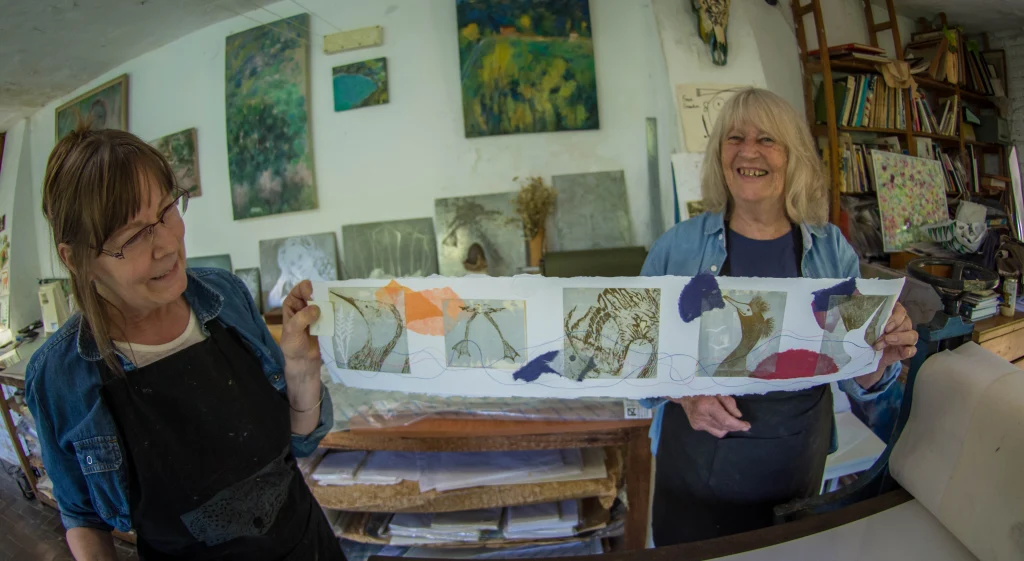
I received an email from Rhonda Horton the other day. Rhonda is a printmaker from Alaska who came over a few years ago and spent a month making prints with me. The novelty was that her husband, Rich, accompanied us in the studio, and played his guitar while we worked. I have music in the studio, but there’s nothing like being accompanied by a live guitarist. Thank you, Rich.
Rhonda made a lot of progress in that month, and when she went home she quickly became one of my most productive artists, applying everything she learned from me—and more—in her own studio. She now offers printmaking courses, and people come. (Alaska needs more indoor sports like printmaking, she affirms.) She has a lovely website (http://, unlike so many sites which limit their offering to sales. Ronda’s site is more of a conversation between a print artist and people who would like to know more about printmaking. Her writing has an easy-going personal touch.
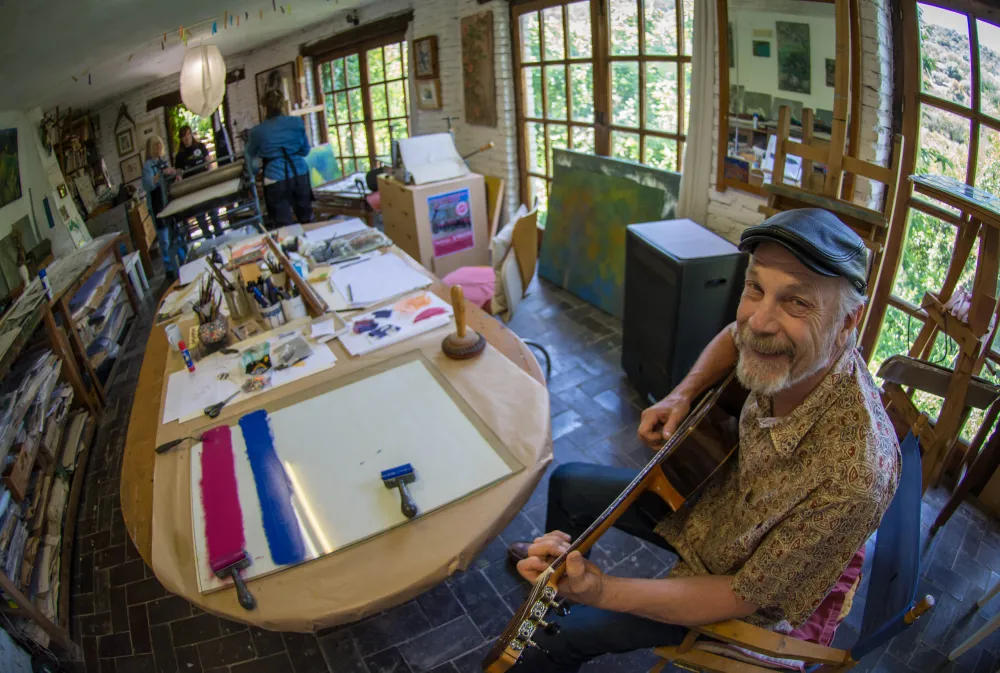
Rhonda’s email was headlined, “Checking out to see how you are doing.” That message is vital when you are corresponding with people who are in their 80’s, and can be translated into, “Are you still kickin’?” Yes, we are, actually. I have been trying to retire from printmaking for a couple of years. My dream has been to have some time just for painting, something I sorely missed during my nearly half century of printmaking. I did get a bit of painting time, but I never succeeded in leaving printmaking. There’s always some artist who needs help with techniques or a project—or both—and I find myself back into prints again. A recent case was that of an extremely creative London-based bass player/music producer/painter who was preparing a show of paintings that were two-and-a-half-meters high. Big work like that makes for an impressive exhibit, but they’re not great for sales. So he was casting about for a more saleable format to accompany his big paintings.
My good friend here in Granada, the ceramicist, Esperanza Romero, introduced him to me. They had participated in the London squatters’ movement in the late 60’s. (Funny how old networks continue to function more than half a century later.) He dropped by my studio, and in less than half a day we had come up with a plan to create solar prints in more reasonable sizes (DIN A-3 and A-4) based on his original drawings on acetates, which I sunburned onto solar plates. He loved the results. The prints are done and delivered, and the show will open in the autumn.
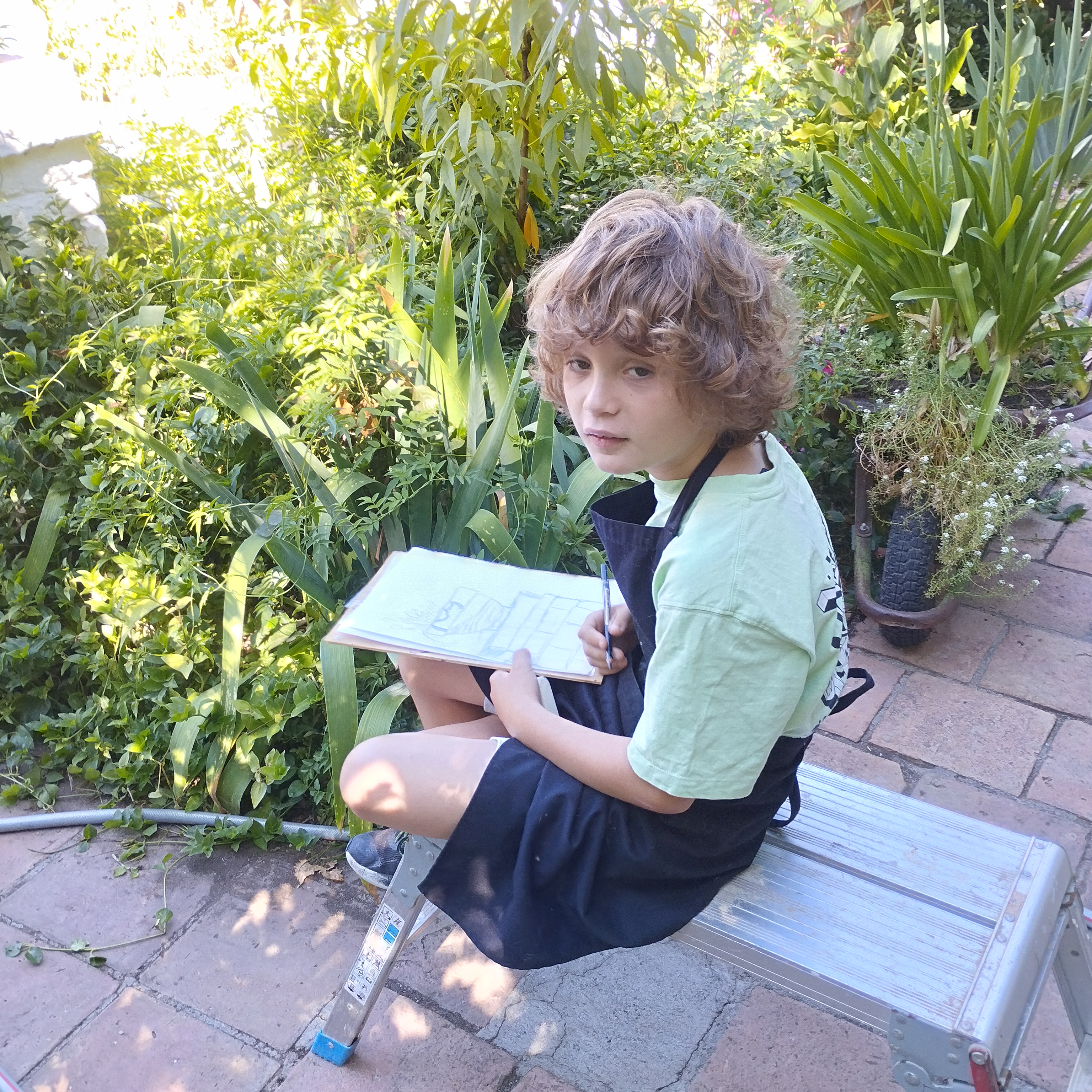
I’ve been saving the best for last. His name is Bruno. Our across-the-valley neighbor, Antoine, stopped by the other day to inquire about the possibility of a three-day workshop for his niece, Gema, and her two children, ages nine and eleven. This is the kind of commission I usually turn down politely, but I couldn’t do that to our old friend, Antoine, a retired French educator and school administrator. So I said, “Sure, bring them along.” We finished the three-day workshop yesterday. It was one of my most gratifying experiences in 45 years of printmaking. I assisted at the birth of a potentially great printmaking artist. His name is Bruno, he’s nine years old, and he’s got it all. The first hint I got was shortly after they arrived on the first day and his mother showed me his sketchbook. It was the work of an artist.
When he stepped into my studio three mornings ago, he had never seen an etching press. (My guess is that he’ll be seeing a lot of them in the not-too-distant future.) His images were shockingly mature, of course, but just as impressive as that, was his attitude of supreme confidence in the studio. In the first ten minutes or so he made it clear that he was taking over and bringing his own criteria along with him. Once he got the drift of printmaking basics, another ten minutes, he was off and running, like a recently-born antelope running ahead of the lions. I have never been so impressed/inspired watching a young printmaker at work.
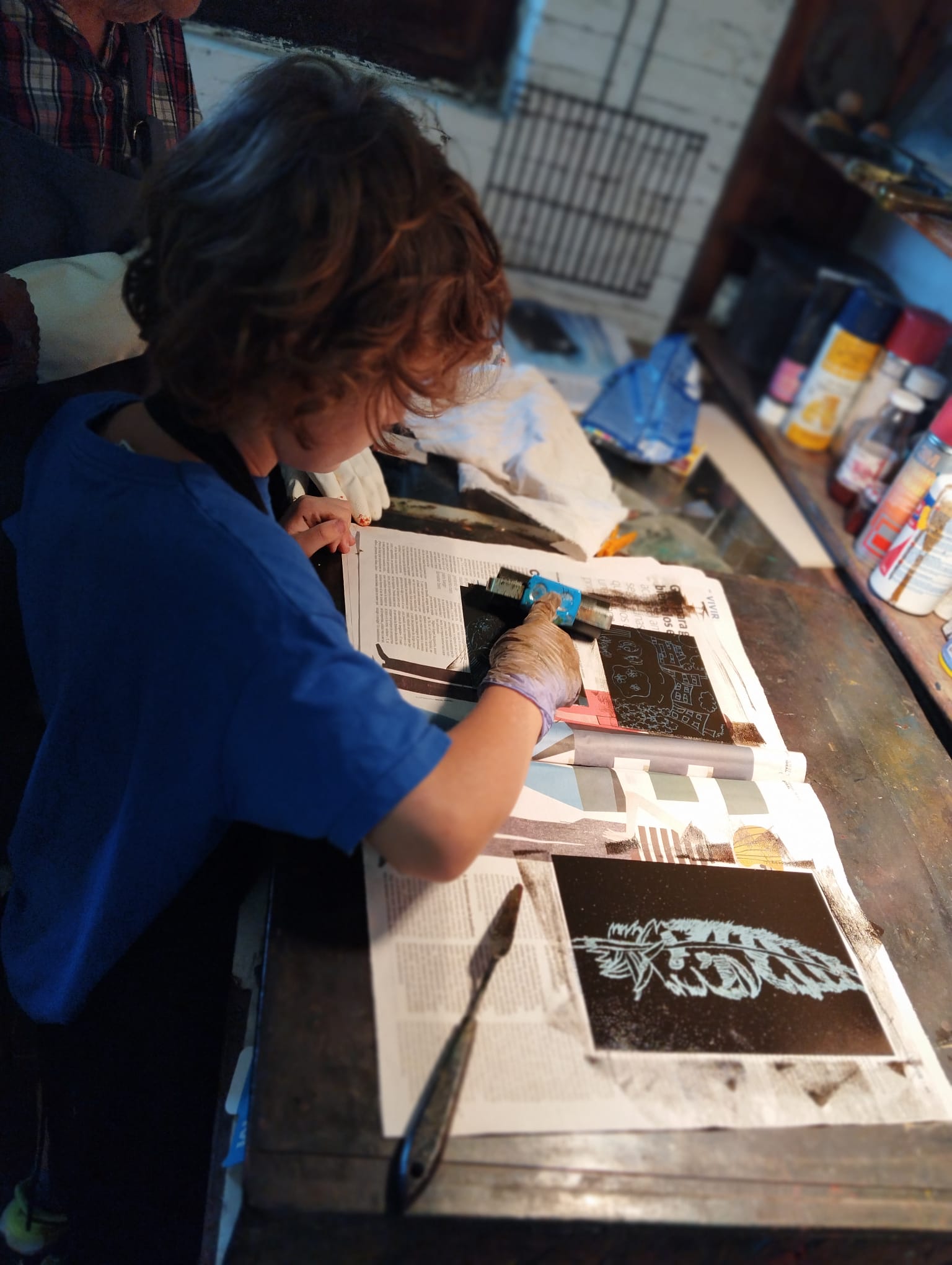
For his first print he drew a big owl feather that was sticking up out of a glass on the table. That took up most of the space on the acetate (the same size as the plate) then he started rummaging around in a shopping bag full of fabric and plastic textures that I have for embellishing images on plates. Bruno quickly selected a couple of them—with the confidence of an old pro—and laid the first one, a plastic gridwork on his first plate. Then he chose an elongated piece of embroidery to put on top of that. Before I could say, “We don’t pile one on top of the other,” Bruno has positioned the embroidery carefully over the plastic grid and was walking toward the etching press. A turn and a half of the big wheel, and out came a beautiful monoprint, a nine-year-old boy’s first. After he made the first work proof in simple black, it was clear he wanted more. So, with my help, he made a second proof print, and then a wonderful ghost print. He was ecstatic with his three prints from his first plate.
Thank you for the printmaking lesson, Bruno. And the inspiration.
###


 Printmaking Courses in Spain
Leave a comment